
The Redesignation
Application Process
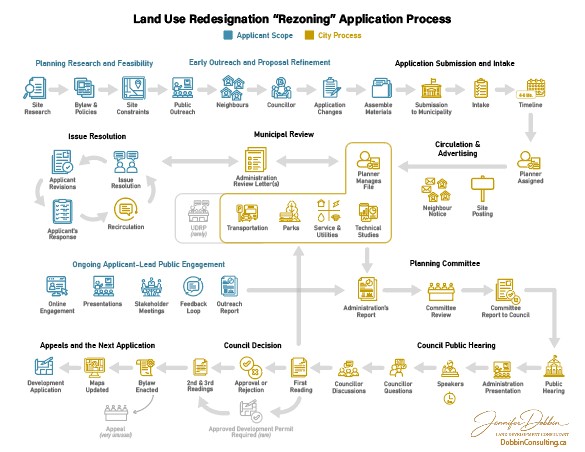
In this video, I explain the common process for changing the zoning or land use designation of a property in Canada, using Calgary as a practical example. The terminology and legal procedures vary by province and municipality, so this is a general educational guide rather than a substitute for reviewing the requirements that apply in a particular location.
Handout, printout, and transcript available at the bottom of page.
How Land Use Redesignation Works
Across Canada, changing what may be built or operated on a property often begins with an amendment to the municipality’s zoning or land-use bylaw.
Different municipalities use different terminology — rezoning, zoning amendment, land-use amendment or land-use redesignation — but the basic purpose is the same: changing the rules that apply to a parcel of land.
This overview explains the general process, using the City of Calgary’s land-use redesignation process as a recurring example.
Most importantly, rezoning the land is not the same as approving the development. A redesignation establishes what uses and development parameters may be considered on the property. Detailed development approval usually comes later.
Someone Proposes a Change in Land Use
Every redesignation begins with an idea.
A landowner, developer or other applicant wants to use or develop a property in a way that is not permitted under its existing zoning.
That might mean changing a residential property to allow more housing, redesignating industrial land for commercial development, permitting a mixed-use project, or changing the range or intensity of uses permitted on a site.
Before anything is submitted, the first question is:
What land-use district is needed to allow the proposed development?
Planning and Policy Research
Before an application is prepared, the site needs to be understood within the larger planning framework.
That means reviewing the existing land-use designation, applicable municipal development plans, local area or neighbourhood plans, transportation considerations, servicing constraints and other relevant policies.
The goal is not simply to determine whether a different land-use district exists.
The important question is whether the proposed redesignation is appropriate for this particular location and supported by municipal policy.
This early research often determines whether an application has a reasonable path to approval — and what issues will need to be addressed along the way.
Early Outreach and Engagement
Depending on the municipality and the nature of the application, engagement may begin before the formal application is submitted.
That can include discussions with municipal planning staff, adjacent landowners, community associations, affected agencies or other stakeholders.
Early engagement can identify issues before they become formal objections.
It also gives the applicant an opportunity to explain what is actually being proposed, understand community concerns and determine where changes may be appropriate.
Good engagement is not necessarily about making everyone agree.
It is about making sure people understand the proposal, have a meaningful opportunity to be heard and that legitimate planning concerns are identified and considered.
Preparing and Submitting the Application
Once the proposed land use and planning rationale are established, the formal redesignation application can be prepared.
In Calgary, this is generally submitted as a Land Use Amendment, or LOC application.
The submission typically includes plans, supporting information and a planning rationale explaining why the proposed land use is appropriate.
Depending on the site and the proposal, additional technical studies may also be required.
Submitting the application is not the end of the planning work.
It is really the beginning of the municipal review process.
Application Intake and Public Notification
The municipality reviews the submission to make sure the required information has been provided before the application moves into circulation and detailed review.
Public notification also begins.
The exact process varies between municipalities, but it may include on-site signage, mailed notices, online application information and circulation to community organizations or neighbouring property owners.
This is often the first time many members of the public become aware that a land-use change has been proposed.
Coordinated Municipal Review
Once the application is underway, it is circulated through the municipality for review.
A redesignation is rarely reviewed by a single planner working alone.
Transportation, utilities, engineering, parks, environmental specialists, urban design staff and other departments or external agencies may all have an interest in the application.
In Calgary, this work is coordinated through the City’s development application review process.
Each reviewer looks at the proposal through a different technical or policy lens.
The planning process is therefore largely an exercise in coordinating and resolving all of those different requirements.
Comments, Revisions and Problem-Solving
The first submission is rarely the last submission.
Municipal reviewers provide comments identifying questions, required changes or additional information.
The applicant team then responds.
Plans may change. Technical studies may be updated. Additional information may be submitted. Some comments require relatively simple corrections; others can involve substantial planning, engineering or design work.
This back-and-forth is a normal part of the process.
A large part of professional land-use planning is identifying which issues genuinely need to be solved, coordinating the specialists who need to solve them and keeping the application moving toward a decision.
Public Engagement During the Review
Public engagement may continue while the application is under review.
Neighbours and community organizations may raise concerns about matters such as traffic, density, building height, parking, privacy, neighbourhood character or infrastructure.
Some concerns can result in changes to the proposal.
Others relate to matters that will be addressed later through a Development Permit rather than through the redesignation itself.
An important part of the planning process is separating those two things.
Land-use approval determines the regulatory framework. A later Development Permit usually determines the detailed design of the development.
Administration’s Recommendation
Once the technical review, policy analysis and engagement process are sufficiently complete, municipal administration prepares its recommendation.
The planning authority considers questions such as:
Does the proposal align with municipal policy?
Is the proposed land use appropriate for the site?
Can transportation and servicing requirements be addressed?
Have significant planning issues been resolved?
Administration then recommends whether the redesignation should be approved or refused.
That recommendation is important — but it is not necessarily the final decision.
Advisory or Planning Commission Review
Some municipalities include an advisory planning body before the application reaches Council.
In Calgary, land-use redesignation applications may proceed through Calgary Planning Commission before being forwarded to City Council.
The Commission reviews the planning merits of the application and administration’s recommendation and makes its own recommendation to Council.
Council, however, remains the decision-maker on the land-use bylaw amendment.
Public Hearing
Because a redesignation changes a municipal land-use bylaw, the application proceeds to a formal public hearing before Council.
Administration presents the application and recommendation.
The applicant has an opportunity to speak.
Members of the public may speak in support or opposition.
Councillors can ask questions of administration, the applicant and members of the public.
This is different from earlier engagement.
The public hearing is part of the formal statutory decision-making process and creates the record Council uses when considering the proposed land-use amendment.
Council Makes the Decision
Council then debates the proposed redesignation and decides whether the land-use bylaw should be amended.
In Alberta, a land-use bylaw amendment proceeds through the required readings of the bylaw before it is adopted.
Council may approve the proposed redesignation, refuse it, or in some circumstances amend what has been presented.
This is ultimately a political decision informed by planning policy, technical analysis, administration’s recommendation, public submissions and Council’s own judgment.
For most applicants, this is the end of the redesignation process.
Council’s decision on a land-use amendment is generally final, subject to limited legal avenues relating to matters such as jurisdiction or errors of law.
Redesignation Is Usually Only the First Approval
An approved redesignation does not normally mean construction can begin.
It changes the land-use rules that apply to the property.
The applicant may still need a Development Permit, subdivision approval, building permits, engineering approvals or other permits before the proposed development can proceed.
That distinction matters.
A redesignation answers:
“Can this type and scale of development be considered here?”
The Development Permit process usually answers:
“What will this particular development actually look like and how will it function?”
How Long Does a Redesignation Take?
Timelines vary significantly by municipality, site complexity, technical requirements, public interest and the number of revisions required.
Even a relatively straightforward application involves several stages of municipal review and statutory decision-making.
In Calgary, a simple application may move through the process relatively quickly, while more complicated applications commonly take several months or longer.
For applicants, one of the most important parts of the process is therefore not simply preparing the first submission — it is actively managing the application from the initial planning strategy through technical review, public engagement and the final Council decision.
Why the Process Matters
Cities do not simply happen.
Every neighbourhood, business district, industrial area, apartment building and redevelopment project sits within layers of planning policy, infrastructure decisions, land-use regulation and public decision-making.
Land-use redesignation is the point where many of those considerations come together.
It is where an idea for a piece of land begins its transition into something a municipality is prepared to allow.
And that is the work of land planning.
Additional Resources:
Process Infographic (PDF)
City of Calgary links:
Land Redesignation Info
(Rezoning Applications info)
Residential Building & Development
(Planning Department info)
Development Map
(open applications)
MyProperty Map (current zoning info)